In Dubai’s fast-moving business environment, traditional access systems are no longer enough. Companies across commercial buildings, warehouses, healthcare facilities, educational institutions, and government sectors are turning to biometric access control system Dubai for stronger security, better accountability, and seamless entry management.
At the same time, regulations are becoming stricter. The UAE Personal Data Protection Law (PDPL) is now fully active, and the UAE AI Act classifies biometric identification as a high-risk technology. This means businesses must think beyond convenience and focus on compliance, privacy, and responsible data handling.
If you are searching for the best biometric access control system in Dubai, this guide gives you everything you need to know. You’ll learn how biometric access systems work, the different technologies available, implementation costs, legal requirements, industry-specific use cases, and the key factors to consider before investing. By the end, you’ll have a clear roadmap for choosing a secure, compliant, and future-ready biometric access solution for your organization in 2026.
What Is a Biometric Access Control System?
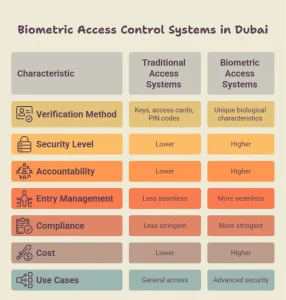
A biometric access control system is a security solution that verifies a person’s identity using unique biological characteristics instead of traditional credentials such as keys, access cards, or PIN codes. Because biometric traits are unique to each individual, they provide a much higher level of security and accountability.
In Dubai, businesses are increasingly adopting biometric access control systems to protect offices, warehouses, data centers, healthcare facilities, residential towers, and government buildings. These systems reduce the risk of unauthorized access while providing accurate records of who entered a facility and when.
Unlike access cards that can be lost or shared, biometric credentials stay with the individual. This makes biometric authentication one of the most secure forms of physical access control available today.
How Biometric Access Control Dubai Works
Modern biometric access control systems use advanced algorithms and sensors to verify a person’s identity within seconds. The process typically follows these steps:
- Captures a Biological Trait
The system scans a unique physical characteristic such as a fingerprint, facial features, iris pattern, or palm vein. - Creates a Digital Template
Instead of storing a raw image, the system converts the biometric data into an encrypted digital template. This template is stored securely on a local server, access control panel, or encrypted cloud platform. - Performs a Real-Time Comparison
When a user requests access, the system captures a live scan and compares it against the stored template using advanced matching algorithms. - Evaluates the Match Score
The software calculates a match score within milliseconds. If the score meets or exceeds the predefined security threshold, the identity is verified. - Grants or Denies Access
The door, gate, turnstile, or secured area unlocks when verification succeeds. If the match fails, access is denied and the event is logged for security monitoring.
This entire process usually takes less than a second, allowing organizations to maintain strong security without creating delays for employees or visitors.
Biometric vs. Traditional Access Control — Key Differences
| Feature | Key Cards | PIN Codes | Biometric Access Control |
| Security Level | Moderate | Moderate | High |
| Risk of Sharing | High | High | Very Low |
| Risk of Loss or Theft | High | None | None |
| Fraud Prevention | Limited | Limited | Excellent |
| Authentication Speed | Fast | Fast | Very Fast |
| Ongoing Costs | Card replacement costs | Minimal | Low after installation |
| User Convenience | Requires carrying a card | Requires memorization | Uses unique biological traits |
| Audit Trail Accuracy | Moderate | Moderate | High |
| PDPL Compliance Support | Limited identity verification | Limited identity verification | Strong identity verification when properly implemented |
| Suitability for High-Security Areas | Moderate | Low to Moderate | Excellent |
For organizations that require stronger security, accurate attendance tracking, and better compliance controls, biometric access control offers significant advantages over traditional card-based and PIN-based systems. This is why many businesses across Dubai are replacing older access systems with biometric solutions that deliver both convenience and enhanced protection.
Types of Biometric Access Control Systems in Dubai
Dubai businesses can choose from several biometric technologies, each designed for different security levels, traffic volumes, and compliance requirements. The best choice depends on your environment, budget, and operational needs.
Fingerprint Recognition Systems
Fingerprint access control remains the most widely deployed biometric solution across UAE offices, warehouses, retail facilities, and industrial sites. These systems are popular because they are affordable, reliable, and easy to integrate with time-attendance software.
Best for
- Medium-traffic entry points
- Employee attendance tracking
- Warehouses and logistics facilities
- Small and medium-sized businesses
Limitations
- Requires physical contact with the scanner
- Hygiene concerns increased after the pandemic
- Less practical in environments where employees wear gloves
Facial Recognition Systems
Facial recognition uses AI-powered cameras to identify individuals without physical contact. This has made it increasingly popular in modern commercial buildings and healthcare facilities.
Best for
- Corporate lobbies
- Hospitals and healthcare facilities
- Government buildings
- High-traffic entrances where speed is important
Important 2026 consideration
Under the UAE AI Act introduced in March 2026, biometric identification technologies such as facial recognition are classified as high-risk AI systems. Organizations deploying these solutions should ensure they have proper governance, transparency, security controls, and compliance procedures in place.
Iris Recognition Systems
Iris recognition analyzes the unique patterns in a person’s iris and offers some of the highest accuracy levels available in biometric authentication.
Best for
- High-security zones
- Government facilities
- Defense installations
- Critical infrastructure environments
Trade-offs
- Higher upfront equipment costs
- More complex deployment requirements
- Slower adoption in mainstream commercial sectors
Multi-Modal Biometric Systems
Multi-modal systems combine two or more biometric factors, such as fingerprint plus facial recognition, to improve security and reliability.
Advantages
- Significantly reduces false rejection rates
- Provides stronger identity assurance
- Maintains access availability if one biometric method is unavailable
Recommended for
- Large enterprises
- Financial institutions
- Organizations with strict security policies
- Businesses preparing for enhanced 2026 compliance requirements
Mobile Biometric Access (Smartphone-Based)
Mobile biometric access uses the biometric capabilities already built into smartphones, such as Face ID or fingerprint authentication, and communicates with doors through Bluetooth or NFC.
Best for
- Tech-forward offices
- Flexible work environments
- Remote and hybrid workforce models
- Organizations seeking touchless access without dedicated biometric readers
Why adoption is growing in Dubai
Many companies prefer mobile credentials because they reduce hardware costs, simplify user management, and align with the UAE’s broader digital transformation initiatives.
Quick Self-Check Quiz
- Which biometric option is most commonly used in UAE offices and warehouses?
Iris recognition
Fingerprint recognition
Mobile biometric access
- Which technology became classified as a high-risk AI system under the UAE AI Act in March 2026?
Facial recognition
Fingerprint recognition
NFC card access
- Which system offers the highest accuracy and is commonly used in government and defense installations?
Mobile biometric access
Iris recognition
PIN-based access
- What is the main advantage of a multi-modal biometric system?
Lower security
Faster card printing
Reduced false rejection rates
- Which access method is especially suitable for hybrid and flexible workforces?
Mechanical keys
Mobile biometric access
Paper visitor passes
Answer Key
- Fingerprint recognition
- Facial recognition
- Iris recognition
- Reduced false rejection rates
- Mobile biometric access
Choosing the Right Biometric Technology
| Business Need | Recommended Technology |
| Cost-effective employee access | Fingerprint recognition |
| Touchless entry for busy facilities | Facial recognition |
| Maximum security and accuracy | Iris recognition |
| Enterprise-grade security with redundancy | Multi-modal biometrics |
| Hybrid workforce and mobile-first access | Mobile biometric access |
For many Dubai organizations, a hybrid approach delivers the best results. For example, companies often use facial recognition for main entrances and fingerprint readers for internal staff-only areas, balancing convenience, security, and compliance requirements.
Why Dubai Businesses Are Upgrading in 2026
For many organizations, upgrading to biometric access control is no longer just about improving security. In 2026, regulatory compliance, data governance, and risk management have become major drivers of investment decisions.
The combination of stricter privacy regulations, increased cybersecurity threats, and evolving workplace security requirements is pushing businesses across Dubai to replace outdated access cards and PIN-based systems with more secure and auditable solutions.
However, deploying biometric technology is not simply a matter of installing new hardware. Organizations must also understand how biometric data is regulated and what legal obligations come with collecting and processing it.
UAE PDPL and Biometric Data — What You Must Know
One of the biggest reasons businesses are reassessing their access control systems is the UAE Personal Data Protection Law (PDPL), officially known as Federal Decree-Law No. 45 of 2021. The law establishes a comprehensive framework for how organizations collect, process, store, and protect personal data.
Under the PDPL, biometric information such as fingerprints, facial images, and iris scans is classified as sensitive personal data. This places biometric data under stricter scrutiny than ordinary business information because it directly relates to an individual’s unique identity.
Before implementing a biometric access control system Dubai, organizations should establish a lawful basis for processing biometric information and clearly document why the data is being collected. In practice, this means businesses should be able to demonstrate a legitimate security purpose, maintain clear policies, and ensure transparency with employees, contractors, and visitors.
Key Compliance Requirements for Biometric Access Systems
Organizations deploying biometric access control should have the following measures in place:
- Explicit and informed consent procedures where required
- A clearly documented business purpose for collecting biometric data
- Written privacy notices explaining how the data is used
- Secure storage and encryption of biometric templates
- Defined retention and deletion policies
- Access controls that limit who can view or manage biometric records
- Procedures for responding to data access and deletion requests
These requirements help organizations demonstrate accountability and reduce the risk of privacy violations.
Data Minimization Matters
A key principle behind modern privacy regulations is that organizations should collect only the data necessary for a specific purpose. Businesses should carefully assess whether biometric identification is genuinely required for a particular security objective and document their decision-making process.
For example, a high-security facility, data center, or critical infrastructure site may have a stronger justification for biometric authentication than a low-risk office environment. Implementing biometric technology without a clearly defined need may create unnecessary compliance risks.
Why Businesses Should Act Now
Many organizations are still operating with legacy access systems that were installed years before today’s privacy and cybersecurity requirements existed. Waiting until enforcement actions occur is a risky strategy.
Forward-thinking businesses are already conducting privacy impact assessments, reviewing access control policies, updating employee consent procedures, and selecting biometric solutions designed with privacy-by-design principles.
By taking action now, organizations can strengthen physical security, improve auditability, and prepare their operations for the increasingly strict regulatory environment expected through 2026 and beyond.
The Cost of Non-Compliance
Failure to properly protect personal information can expose organizations to significant legal, financial, and reputational consequences. Depending on the nature of the violation and the applicable legislation, penalties related to unlawful disclosure of personal data and cybercrime offenses may reach substantial amounts under UAE law. In addition to financial penalties, organizations may face investigations, operational disruptions, and lasting damage to stakeholder trust.
The message for Dubai businesses is clear: biometric access control is no longer just a security decision. It is a compliance decision, a governance decision, and increasingly, a business continuity decision.
UAE AI Act 2026 — Impact on Facial Recognition Systems
The UAE AI Act, effective March 2026, marks a major turning point for biometric technologies in Dubai, especially facial recognition systems used for access control. Under the new framework, real-time biometric identification is officially classified as a high-risk AI application, meaning it is now subject to stricter governance and oversight.
For businesses, this is not just a technical update—it directly affects how facial recognition systems can be deployed and managed in workplaces, commercial buildings, and public-facing environments.
Key Regulatory Requirements for Facial Recognition
Organizations using AI-powered facial recognition must now implement the following controls:
- Algorithm audit and performance validation before deployment
- Human oversight mechanisms for decision verification in edge cases
- Mandatory incident reporting for system failures or misidentification events
- Documented risk assessments aligned with AI governance standards
In addition, businesses are expected to register their use of high-risk AI systems with the relevant UAE AI regulatory authority and complete formal self-assessment documentation within the required compliance timeline (with initial checkpoints expected by mid-2026).
This shift significantly increases the compliance responsibility for companies relying on facial recognition for access control, attendance tracking, or visitor management.
Why This Matters for Dubai Businesses
Facial recognition is no longer a plug-and-play security upgrade. It now requires structured governance, transparent documentation, and ongoing monitoring.
Organizations that fail to align with these requirements risk operational restrictions, compliance penalties, and reputational damage—especially in regulated environments like finance, healthcare, and government-linked entities.
For this reason, many companies are now reassessing whether they should:
- Continue using facial recognition with upgraded compliance frameworks
- Shift to multi-modal biometric systems for reduced regulatory exposure
- Or adopt hybrid models combining facial and fingerprint authentication
Dubai’s Smart City Push and Security Infrastructure Demand
Dubai’s rapid transformation into a global smart city is another major driver behind the surge in biometric access control adoption.
As part of its digital-first vision, the city continues to modernize infrastructure across commercial real estate, logistics hubs, free zones, and government-linked developments. This transformation is not optional for many organizations—it is becoming the new baseline.
Rising Security Standards Across Key Developments
Large-scale projects and economic zones are setting higher expectations for access control systems:
- EXPO City Dubai is building next-generation smart homes with integrated security ecosystems
- DIFC (Dubai International Financial Centre) enforces strict data governance and secure identity verification standards for tenants
- Dubai South developments are adopting advanced access control systems as part of logistics and aviation growth
These environments are pushing the market toward faster, smarter, and more secure authentication systems that can integrate seamlessly with digital infrastructure.
Phase-Out of Legacy Systems
Traditional card-based access systems are increasingly being replaced in new developments. While they are still in use in older buildings, they are no longer considered sufficient for modern security expectations in Dubai’s smart city ecosystem.
New construction projects now commonly require:
- Biometric or mobile-based authentication systems
- Centralized access control platforms
- Real-time monitoring and audit capabilities
- Integration with smart building management systems
This shift is not just about security—it is about creating fully connected environments where access control becomes part of a broader digital infrastructure.
Key Benefits of Biometric Access Control in Dubai
Beyond compliance and modernization, biometric systems offer tangible operational and financial advantages that are driving adoption across industries.
Stronger Security Without the Human Error Factor
Biometric systems eliminate many of the weaknesses found in traditional access control methods:
- Biometric traits cannot be shared, stolen, or forgotten
- “Buddy punching” in attendance systems is completely removed
- Insider threat risks are significantly reduced at restricted entry points
Because identity is tied directly to the individual, organizations gain a much higher level of trust in their access logs.
Operational Efficiency at Scale
Biometric systems also improve day-to-day operational flow, especially in large or high-traffic environments:
- Faster entry processing in hospitals, airports, and corporate campuses
- Automated attendance tracking without manual intervention
- Real-time integration with HR, payroll, and ERP systems
This reduces administrative workload and improves workforce visibility across the organization.
Long-Term Cost Reduction
While initial setup costs can be higher than traditional systems, biometric access control typically delivers strong long-term savings:
- No recurring expenses for key cards, replacements, or PIN resets
- Lower maintenance requirements over a 3–5 year lifecycle
- Faster ROI, often achieved within 18–24 months for mid-to-large enterprises
Over time, the system becomes more cost-efficient while simultaneously improving security and compliance.
Biometric Access Control System Dubai — Sector-by-Sector Use Cases
Different industries in Dubai adopt biometric access control in different ways, depending on their security needs, workforce structure, and regulatory environment.
Corporate Offices and Free Zones
Corporate environments often require flexible yet secure access management systems:
- Role-based access permissions across departments
- Integration with visitor management systems
- Additional governance requirements in zones like DIFC and ADGM
These environments prioritize both convenience and compliance.
Healthcare Facilities
Healthcare providers use biometric systems to protect sensitive areas and improve operational safety:
- Restricted access to pharmacies, patient records, and operating theatres
- Contactless authentication to reduce contamination risks
- Strict compliance with PDPL due to sensitive medical data handling
Educational Institutions
Schools, colleges, and universities use biometric systems for both security and attendance management:
- Controlled access to labs, libraries, and staff-only zones
- Automated attendance tracking for students and staff
- Enhanced protections when handling minors’ personal data under PDPL
Warehouses and Industrial Sites
Industrial environments require robust, scalable access systems:
- Shift-based access control for large workforces
- Integration with ERP systems for workforce tracking and payroll automation
- Choice between fingerprint or facial recognition based on working conditions
Hotels and Hospitality
The hospitality sector uses biometrics to improve guest experience and operational efficiency:
- Mobile biometric access for guest rooms
- Secure staff-only access for back-of-house operations
- Integration with property management systems (PMS) for seamless operations
How to Choose the Right Biometric Access Control System in Dubai
Selecting the right system requires careful planning rather than a one-size-fits-all approach.
Define Your Access Points and Traffic Volume
Start by understanding your environment:
- Single-site vs multi-site deployments require different architectures
- High-traffic entrances require sub-second authentication speed
- Low-traffic zones may prioritize cost-efficiency over speed
Check PDPL and AI Act Compliance Before Buying
Before selecting any vendor, ask critical compliance questions:
- Where is biometric data stored?
- Is it encrypted at rest and in transit?
- Does the system meet AES-256 encryption standards and TLS 1.2+ transmission security?
- Is a Data Processing Agreement (DPA) provided?
For facial recognition systems, also confirm:
- Human oversight is built into decision workflows
- Audit trails are automatically recorded
- AI governance requirements are documented and supported
Evaluate Integration Capabilities
A modern system should integrate with your existing infrastructure:
- CCTV and alarm systems
- HR and payroll platforms
- Enterprise resource planning (ERP) systems
Cloud-based platforms are increasingly preferred for multi-site visibility and centralized control.
Total Cost of Ownership — What to Budget For
A realistic budget should include more than just hardware:
- Hardware: AED 800 – 8,000+ per terminal
- Software licensing: subscription or one-time fee models
- Installation and cabling: varies by site complexity
- AMC (Annual Maintenance Contract): typically 15–20% of hardware cost
- Compliance setup: consent workflows, DPAs, and retention policies
Questions to Ask Every Vendor in Dubai
Before committing, evaluate vendors using these questions:
- Are you a certified installer or only a reseller?
- What is your SLA for downtime and support response?
- Do you provide training and documentation?
- How do you handle PDPL deletion requests?
- Do you have proven experience in your industry sector?
Top Biometric Access Control Brands Available in Dubai
The Dubai market includes several widely used biometric system providers.
ZKTeco
A widely available option across the UAE, popular for cost-effective fingerprint and facial recognition systems. It is commonly used in SMEs and mid-market deployments.
Suprema
Known for advanced biometric technology and strong compliance documentation, making it a preferred choice for corporate and government environments.
Akuvox
Offers hybrid IP-based intercom and biometric solutions, widely used in residential buildings and hospitality sectors.
What to Look for Beyond the Brand
In Dubai’s market, brand name alone is not enough. You should also evaluate:
- Local after-sales support availability
- Spare parts accessibility
- Frequency of firmware updates
- Whether the vendor has a real UAE-based support office
Biometric Access Control Installation Process in Dubai
A structured installation process ensures both performance and compliance.
Site Assessment and System Design
- Map all access points and restricted zones
- Analyze traffic volume and peak usage times
- Consider environmental conditions (outdoor devices require IP65+ rating)
Installation and Commissioning
- Hardware installation, cabling, and network setup
- Software configuration and system integration
- Enrollment of biometric data with documented consent under PDPL
Staff Training and Go-Live
- Simple end-user onboarding due to intuitive biometric use
- Focused training for administrators and IT teams
Ongoing Maintenance and Compliance Reviews
- Regular firmware updates and hardware inspections
- Annual review of data retention policies
- Access audits when employees change roles or leave the company
Conclusion
Navigating Dubai’s fast-evolving business landscape requires a delicate balance between absolute physical security and strict regulatory compliance. As we move through 2026, relying on legacy access cards or unmonitored security systems is no longer just an operational risk—it’s a legal liability. With the UAE Personal Data Protection Law (PDPL) fully enforced and the UAE AI Act placing strict, high-risk guardrails around facial recognition, implementing biometric access control is a highly strategic corporate decision.
Don’t leave your security or compliance to chance. Connect with Connect FM today for a comprehensive consultation. Our team of local experts will help you design, install, and maintain a secure, future-ready, and fully compliant biometric access control system Dubai tailored exactly to your industry’s needs.
FAQs
1: Is biometric access control legal in Dubai?
Yes, it is legal when implemented in compliance with UAE PDPL requirements and data protection standards.
2: What is the cost of a biometric access control system in Dubai?
Costs vary widely depending on system type, ranging from AED 800 to AED 8,000+ per terminal, excluding installation and software fees.
3: Does UAE PDPL apply to employee biometric data?
Yes, biometric data is classified as sensitive personal data under PDPL and requires strict handling.
4: How does the UAE AI Act 2026 affect facial recognition?
It classifies facial recognition as high-risk AI, requiring audits, oversight, and compliance reporting.
5: Which system is best for warehouses?
Fingerprint or facial recognition systems are most commonly used depending on environmental conditions.
6: Can biometric systems integrate with payroll?
Yes, most modern systems integrate directly with HR and payroll platforms.
7: How long does installation take?
Small systems may take 1–3 days, while large enterprise deployments may take several weeks.
8: What happens to biometric data when an employee leaves?
Data must be securely deleted or anonymized according to PDPL retention and deletion policies.